The name on the truck door is rarely the whole story. Behind many shipments is a freight broker that chose the trucking company, and a shipper whose goods were on board. For years, freight broker liability was a dead end in court no matter how carelessly a broker picked a carrier. In May 2026, the United States Supreme Court ended that argument, in a case that began with a crash on an Illinois roadside.
Shawn Montgomery was stopped on the side of an Illinois road when a semi veered off course and struck his tractor-trailer. He lost his leg. The truck was driven for a motor carrier that, he alleged, held a conditional safety rating from federal regulators, with documented deficiencies in driver qualification, hours of service, and maintenance. The shipment had been arranged by C.H. Robinson, one of the country's largest freight brokers, and Montgomery alleged the broker knew or should have known that hiring that carrier was likely to end in exactly this kind of crash.
The lower courts threw the broker claim out, holding it preempted by the Federal Aviation Administration Authorization Act. On May 14, 2026, the Supreme Court unanimously reversed. The Court held that a claim that one company negligently hired another to transport goods is not preempted, because states retain authority to regulate safety with respect to motor vehicles. In the Court's words, requiring the broker “to exercise ordinary care in selecting a carrier therefore ‘concerns’ motor vehicles—most obviously, the trucks that will transport the goods.”
The decision resolved a split among federal appeals courts and overruled the rule that had governed Illinois federal courts since 2023. Freight broker liability claims for negligent carrier selection are now viable nationwide.
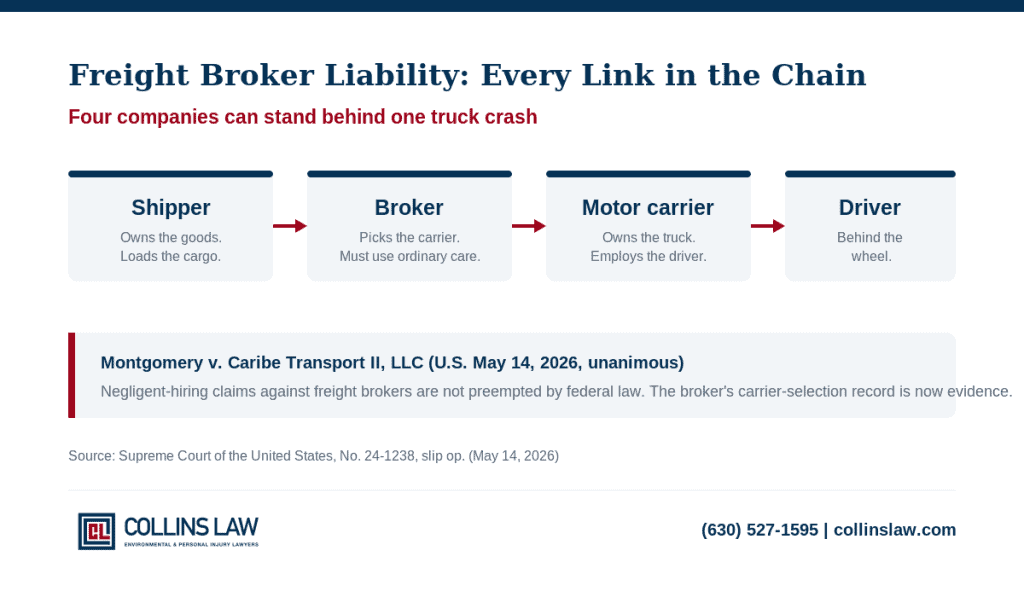
The decision does not make brokers automatically liable; the claim still has to be proven. It means the question a jury will now be allowed to ask is the right one: did the broker exercise ordinary care when it chose this carrier? That question is answered with records:
The shipper, the company whose goods are on the truck, can also bear responsibility in the right case: where it negligently loaded or secured the cargo, where it retained control over how the transportation was performed, or where it selected the carrier itself. These theories are fact-specific and less settled than broker liability after Montgomery, but in catastrophic cases every company in the chain deserves scrutiny, because each brings its own insurance and its own duties.
Catastrophic truck crash injuries routinely exceed a single carrier's insurance, and some carriers are thinly capitalized companies that dissolve after a serious crash. Brokers and shippers are often substantial companies with substantial coverage. Montgomery means the broker's conduct is now part of the case, alongside the driver's and the trucking company's. Identifying every responsible party, fast, is one of the most consequential things a truck accident lawyer does, and the records that prove broker negligence must be preserved just as urgently as the truck's own data.
Yes. In Montgomery v. Caribe Transport II, decided May 14, 2026, the Supreme Court unanimously held that freight broker liability claims based on negligent hiring are not preempted by federal law. Brokers who select unsafe carriers can be held accountable.
No. The decision means the claim can be heard, not that it automatically wins. The case turns on whether the broker exercised reasonable care in selecting the carrier.
The shipper owns the goods, the carrier owns the truck and employs the driver, and the broker is the matchmaker between them. Each relationship can carry its own legal responsibility.
The carrier's federal safety record at the time of hire and the broker's own vetting file. Both need to be preserved quickly.
Montgomery began with an Illinois crash and changed the law for the whole country. If a commercial truck injured you or a family member, every company in the chain that put that truck on the road deserves scrutiny. Call Collins Law Group at (630) 527-1595 or use our contact form. The consultation is free, and there is no fee unless we win.
Serious truck crashes frequently cause traumatic brain injuries and spine or disc injuries. Freight broker liability claims often connect to these related practice areas:
"*" indicates required fields