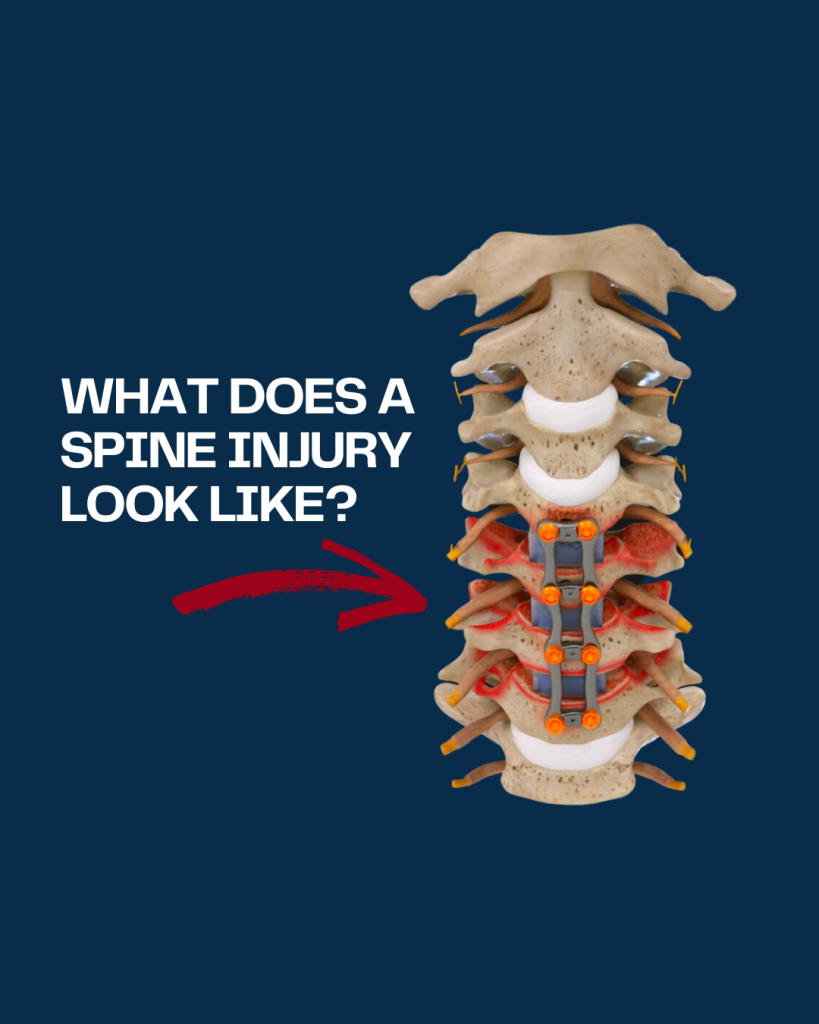
Spine injuries are among the most serious and life-altering injuries a person can suffer. Unlike a sprain or strain that heals with time, a true spine injury, particularly one involving disc damage, vertebral fractures, or spinal cord trauma, can permanently change the way a person lives, works, and moves. Many of these injuries require surgery, including spinal fusion, and many leave the victim with chronic pain, reduced mobility, or permanent disability for the rest of their life.
If you or a family member has suffered a spine injury due to someone else's negligence, you need a lawyer who understands both the medicine and the value of the case. Spine cases are complex. The insurance companies and defense lawyers on the other side know that the difference between a six-figure case and a seven or eight-figure case often comes down to how the medical evidence is developed, presented, and tried. The catastrophic injury attorneys at Collins Law Group have a long track record of taking serious spine cases to verdict and securing the compensation our clients need to rebuild their lives.
Get a free, no-obligation case review. We're available 24/7 and you pay nothing unless we win.
The crashes that produce serious spine injuries are rarely exotic. Rear-end collisions at ordinary speeds transmit force through the seat directly into the cervical and lumbar spine. Side-impact crashes twist the spine in ways it was never built to absorb. Truck accidents bring mass and momentum that turn a survivable collision into a life-changing one, and rideshare crashes add layered insurance questions on top of the medicine. In each of these, the biomechanics matter: how the force traveled, what it did to discs and vertebrae, and why this crash caused this injury. We work those questions up with experts from the beginning, because they are exactly where the defense will attack.
A selection of recent spine injury results obtained by Collins Law Group:
Will County jury verdict for two plaintiffs who required spine surgery after a rear-end collision. The combined pretrial offer was $50,000. John D. Risvold was brought in as trial counsel shortly before expert discovery and tried the case to verdict.
DuPage County jury verdict in a rear-end crash that caused four spine surgeries. After State Farm refused to pay fair value on the underlying injury claim, we sued the carrier for insurance bad faith and won.
Settlement for a client who suffered catastrophic spine injuries in a head-on collision and required fusion surgery.
Settlement against a commercial trucking defendant in a crash that caused fusion-level spine injuries to our client.
Settlement following a semi-truck collision that resulted in spine injuries requiring surgical repair.
Past results do not guarantee future outcomes. For additional case results across the firm's practice areas, see our Case Results page.
The spine protects the spinal cord, which carries every signal between the brain and the rest of the body. When the spine is damaged, the consequences can range from chronic pain and limited mobility to total paralysis. According to the National Spinal Cord Injury Statistical Center, there are approximately 18,000 new spinal cord injuries in the United States each year, and roughly 300,000 Americans currently live with one. That figure does not include the much larger population of people who suffer disc injuries, vertebral fractures, and other structural spine damage that, while not necessarily severing the cord, can still require surgery and result in lifelong pain and disability.
Catastrophic spine injuries are different in kind, not just degree, from a typical neck or back strain. They are diagnosed with imaging that shows actual structural damage: herniated or extruded discs, fractured vertebrae, ligament tears, or spinal cord compression. These injuries often cannot be resolved without surgery, and even after surgery, many victims are never the same.
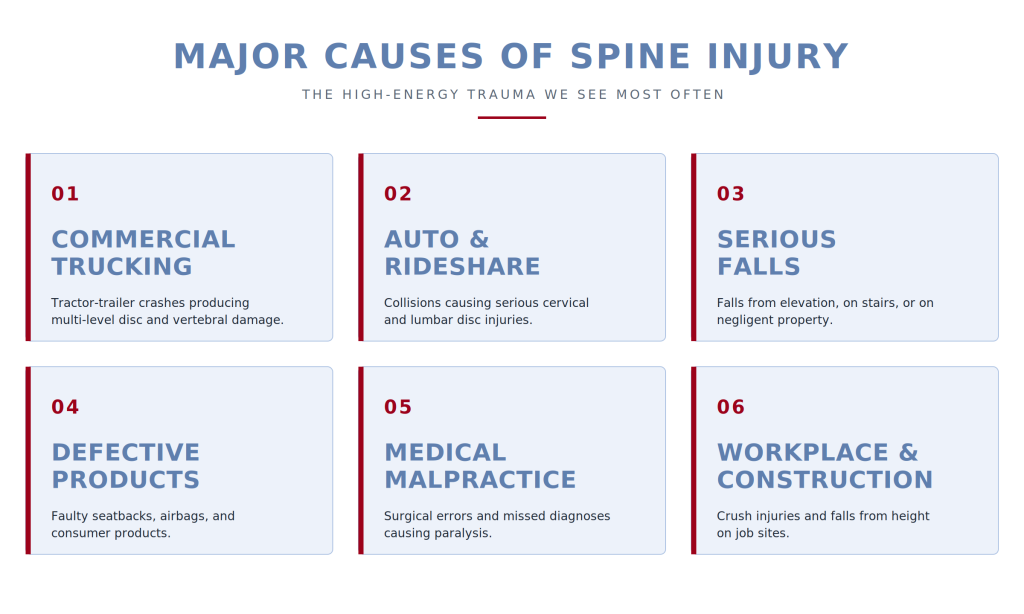
The spine cases we handle most often involve high-energy trauma. The following are the leading causes of serious spine injuries we see in our practice:
Commercial trucking and semi-truck crashes. Collisions involving tractor-trailers and other large commercial vehicles routinely cause catastrophic spine injuries. The mass and force involved in a truck crash can crush vertebrae, herniate multiple disc levels at once, and damage the spinal cord. These cases often involve federal motor carrier regulations, hours-of-service violations, and corporate defendants with significant insurance coverage available to compensate victims.
Car, rideshare, and other motor vehicle crashes. Even at moderate speeds, rear-end and side-impact car accidents can cause serious cervical and lumbar disc injuries that require surgical repair. Rideshare crashes involving Uber and Lyft drivers raise additional issues regarding which insurance policies apply and how much coverage is available.
Serious falls. Falls from elevation, on dangerous stairs, or on improperly maintained property are among the leading causes of severe vertebral fractures and compression injuries, particularly in older adults. A catastrophic slip and fall in a nursing home, on a construction site, or due to a negligent property condition can fracture the spine and require multi-level fusion.
Defective and dangerous products. Vehicle defects, such as faulty airbags, defective seatbacks, and poor structural design, can directly cause spine injuries that a properly designed product would have prevented. Industrial equipment, ladders, and consumer products that fail under foreseeable use are also a frequent source of catastrophic spine cases.
Medical malpractice. Surgical errors, anesthesia errors, and medical negligence involving failures to diagnose conditions such as spinal cord compression, epidural abscess, or cauda equina syndrome can leave a patient with permanent paralysis. Surgery performed at the wrong level of the spine is one of the more common forms of spine-related malpractice.
Construction injuries. Crush injuries, falls from height, and being struck by heavy equipment on a job site frequently cause catastrophic spine damage. Many of these cases involve third-party liability.
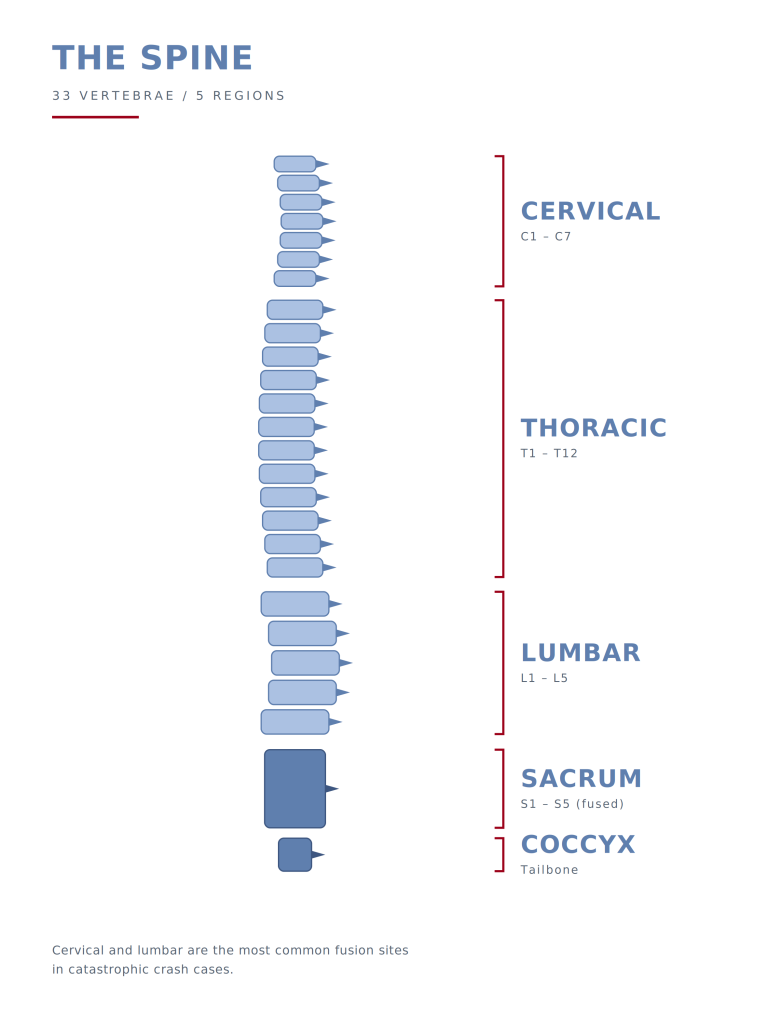
The spine is made up of 33 vertebrae divided into the cervical (neck), thoracic (mid-back), lumbar (lower back), sacral, and coccyx regions. Between each vertebra is a disc that absorbs shock and allows movement. Damage at any level can cause significant impairment, but the type and location of the injury drive both the treatment and the value of the case.
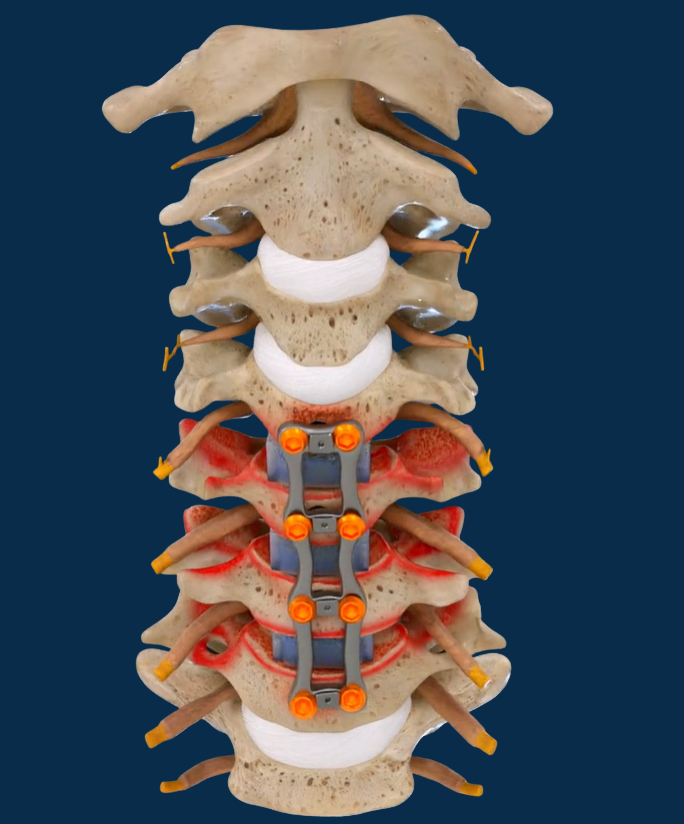
Spinal fusion is a surgical procedure in which two or more vertebrae are permanently joined together using bone graft, metal plates, screws, and rods. The goal is to stabilize the damaged segment of the spine, eliminate the movement that is causing pain or nerve compression, and prevent further injury. Fusion is typically recommended when more conservative care, including physical therapy, injections, and time, has failed to resolve the underlying structural problem.
Many of the catastrophic spine cases we try involve fusion surgery. A single-level cervical fusion is a major procedure. Multi-level fusions, lumbar fusions, and revision fusions are larger surgeries with longer recoveries and greater long-term consequences. After a fusion, the joined segment of the spine no longer moves, which often accelerates wear on the adjacent levels, a phenomenon known as adjacent segment disease. It is common for patients who have one fusion to eventually need additional surgery on the levels above or below.
Defense lawyers and insurance carriers routinely attempt to minimize the significance of fusion surgery. They argue that the surgery was elective, that the underlying degeneration was pre-existing, or that the patient should have recovered fully. We are familiar with these defense strategies and know how to counter them with the medical evidence, expert testimony, and trial preparation that catastrophic spine cases demand.
Any of these symptoms following a crash, fall, or other traumatic event should be evaluated immediately. Spinal cord injuries in particular are time-sensitive, and early intervention can affect the long-term outcome.
A serious spine injury rarely returns a person to their pre-injury baseline. Common long-term effects include:
If you are over the age of 30, your MRI almost certainly shows some disc degeneration, because nearly everyone’s does. Defense lawyers know this. Yet, their favorite argument in every disc case is that the herniation was already there, the crash changed nothing, and your pain is just age, arthritis or normal wear and tear. If your lawyer does not know how to dismantle that argument, it works.
We dismantle it with evidence. We use prior medical records showing you never treated for back pain before the crash. Imaging comparisons where prior films exist. We speak with treating surgeons who can explain the difference between quiet degeneration and an acute, symptomatic herniation. Co-workers and family will testify and can describe the person you were the day before the collision and the person you have been since. Illinois law compensates an injury even when the crash aggravated a condition that was already there. The defense does not get a discount because your spine was human.
The other favorite defense of insurance companies is that the crash was not at a high enough speed or a significant enough impact to cause your injuries. The fact of the matter is that cars were designed to crash, but our bodies were not. Defendants use photographs of modest bumper damage shown to a jury with the suggestion that a small dent cannot cause a real injury. Vehicle damage measures what happened to the car, not what happened to the spine inside it. Low-speed collisions can and do herniate discs, especially in rear-end impacts where the body is unbraced. We counter the photographs with real medicine, using treating physician testimony, consistent symptom documentation from the first ER visit forward, and, where the case warrants it, biomechanical analysis and expert witnesses. This is another reason to get medical attention immediately and follow through on treatment. Defendants will sieze on gaps in care to argue that some other thing caused your injuries. These gaps are the defense’s best friend.
In most Illinois personal injury cases, you have two years from the date of the injury to file a lawsuit. 735 ILCS 5/13-202. Some situations change that deadline: claims involving government entities can have much shorter notice requirements, and different rules can apply to minors. Waiting also costs evidence: vehicles get repaired, camera footage gets overwritten, and witnesses move. The safest move after a serious injury is to talk to a lawyer well before any deadline is close. The consultation is free.
Yes, in many cases. Illinois follows a modified comparative negligence rule: you can recover compensation as long as you were not more than 50 percent responsible for what happened, and your recovery is reduced by your percentage of fault. 735 ILCS 5/2-1116. In other words, being partly at fault does not end your case; even at exactly 50 percent responsibility, recovery is still possible. Insurance companies know this rule and often try to push more blame onto the injured person, which is one of the main reasons to have a lawyer handling those conversations.
No. Degenerative findings appear on most adults’ imaging. The legal question is whether the crash caused or aggravated a symptomatic injury, and Illinois law compensates aggravation of a pre-existing condition. This defense is beaten with medical records, imaging comparison, and credible treating-physician testimony.
Surgery usually increases the medical specials and often the overall value, but unoperated cases with permanent pain and work restrictions can still be substantial. Value turns on permanence, credibility, and proof, not just the procedure list.
An “independent” medical examination is an evaluation by a doctor selected and paid by the defense. It is neither independent nor a treatment visit. We prepare every client before an IME and confront its conclusions with your actual treatment history.
Yes. Passengers are almost never at fault, and claims may run against any combination of drivers, including the driver of the car you were in.
Some crashes injure not just the discs and vertebrae but the spinal cord itself, causing partial or complete paralysis. Those cases involve different medicine, different experts, and different lifetime damages, and we handle them as spinal cord injury cases. If the injury has permanently changed how you live and work, it belongs with our catastrophic injury team either way.
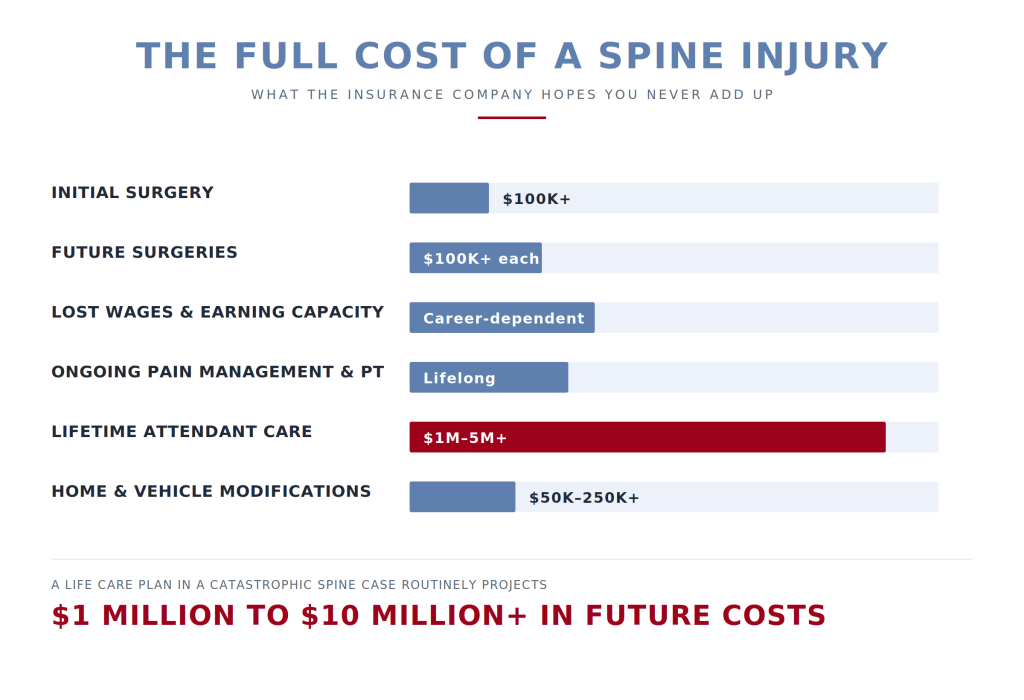
Catastrophic spine injuries are among the most expensive injuries in the personal injury system. A single-level fusion surgery can cost upwards of $100,000 once the hospital, surgeon, anesthesia, hardware, and rehabilitation are accounted for. Multi-level fusions and revision surgeries cost significantly more.
Beyond the immediate medical costs, a spine injury victim typically faces lost wages during recovery, diminished earning capacity if they cannot return to their prior work, ongoing pain management, physical therapy, future surgeries, and in the most catastrophic cases, lifetime attendant care and home modifications. A life care plan prepared by a qualified expert in a serious spine injury case can easily project several million dollars in future costs. When a spine injury results in death, families may also have a wrongful death claim.
These figures are why proper case preparation matters. The insurance company's first offer is rarely close to what the case is actually worth. Without an attorney who knows how to document the full extent of the injury and the full economic and non-economic damages, a spine injury victim and their family can be left holding bills the negligent party should be paying.
If you or a family member has suffered a catastrophic spine injury because of someone else's negligence, you need an experienced trial lawyer in your corner from the beginning. Call Collins Law Group at (630) 527-1595 for a free evaluation of your case. We handle catastrophic spine injury cases throughout Illinois on a contingency basis. There is no fee unless we win.
Spine injury cases frequently overlap with the following practice areas:
"*" indicates required fields