Get a free, no-obligation case review. We're available 24/7 and you pay nothing unless we win.

A spinal cord injury changes everything in an instant. Paralysis, loss of independence, and a lifetime of medical care are not setbacks you simply recover from. Collins Law Group represents people across Naperville, DuPage County, and the greater Chicago area who have suffered spinal cord injuries and paralysis because someone else was careless. These are among the most serious cases we handle, and we handle them relentlessly.
If your injury was caused by another person or company, you should not have to carry the financial weight of their mistake for the rest of your life. We fight to recover the full cost of your care, your lost future, and the life that was taken from you, not the discounted figure an insurance company would prefer to pay. The consultation is free, and you owe no fee unless we win.
Call (630) 527-1595 for a free, confidential consultation. If you cannot come to us, we will come to your home or hospital room.
The spinal cord carries the signals between your brain and the rest of your body. When it is damaged, those signals can be interrupted or lost below the point of injury, which is what causes paralysis. Doctors generally describe these injuries in two ways:
Where the injury falls on the spine, and whether it is complete or incomplete, shapes the care a person will need for the rest of their life. That is also why no two spinal cord injury cases are the same, and why each one has to be built around the specific person.
Two distinctions drive everything in these cases. The first is complete versus incomplete: a complete injury severs all signal below the level of damage, while an incomplete injury leaves some sensation or motor function, sometimes with real potential for partial recovery, which makes early, aggressive rehabilitation critical. The second is the level of injury. Damage in the cervical spine can cause tetraplegia, affecting all four limbs and sometimes the ability to breathe without assistance. Damage lower, in the thoracic or lumbar regions, typically causes paraplegia, affecting the legs, bowel, bladder, and sexual function. Where the injury sits and how complete it is determine what a lifetime of care requires, and therefore what the case must recover.
Many spinal cord injuries are caused by preventable conduct. When they are, we hold the responsible party accountable. Common causes include:
When a spinal cord injury is fatal, we also represent families in wrongful death claims.
Motor vehicle crashes remain the leading source of the spinal cord cases we see: car crashes with rollover or roof crush, commercial truck collisions whose sheer force fractures vertebrae into the cord, motorcycle riders thrown at speed, and rideshare crashes with their layered insurance coverage. We also see cord injuries from workplace and construction incidents, diving into unmarked shallow water, and medical negligence during spinal procedures. Whatever the mechanism, the questions are the same: who had the duty, who had the insurance, and what will this injury cost over a lifetime.
A spinal cord injury is not a one-time expense. The cost stretches across a lifetime, and it is often substantial. Depending on the injury, it can include:
Insurance companies know these numbers are large, which is exactly why they push for a fast, low settlement before the full lifetime cost is documented. We do the opposite. We document all of it.
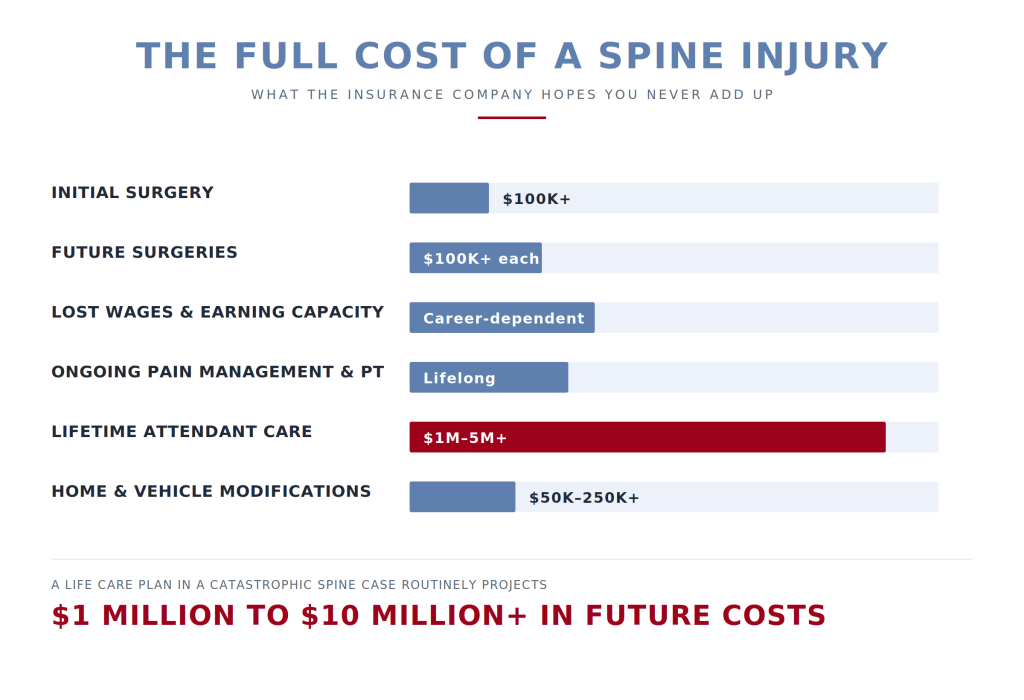
The verdict or settlement is the only chance to fund the rest of a life, so we build the number the way a life-care planner builds a plan, item by item. Attendant care, the largest line in most plans, whether provided by professionals or by family members whose labor the law recognizes has value. Wheelchairs and mobility equipment, replaced on a cycle for life, not purchased once. Home modifications: ramps, widened doorways, roll-in showers, lifts, and sometimes a different home altogether. Vehicle modifications or accessible transportation. The medical complications that follow cord injuries, including pressure injuries, urological and bowel management, respiratory care at higher injury levels, spasticity treatment, and pain management. Lost earnings and lost earning capacity across a working lifetime. And the damages Illinois law recognizes beyond the invoices: pain, loss of a normal life, and disfigurement.
Lifetime costs in these cases routinely run into the millions of dollars. A settlement that looks large but funds only a few years of attendant care is not a victory, and we have seen what early lowball offers do to families a decade later. We prepare every spinal cord case for trial so the defense pays for the whole life, not the first chapter of it.
We build spinal cord injury cases with a team of experts who establish both what happened and what the rest of your life will require:
Together, this evidence turns a lifetime of need into a documented figure that an insurance company, and a jury, cannot dismiss.

People come to us at the hardest moment of their lives, and we never lose sight of that. To us, you are a person, not a file number. We take care of our clients, we genuinely care about them, and we are dedicated to getting them the best possible outcome, both for their case and for their lives.
Call (630) 527-1595 or request a free consultation. There is no fee unless we win your case.
If your family member is in the hospital or in acute rehabilitation, focus on their care; that comes first. But three things protect the case while you do. Preserve everything: the vehicle, the helmet, the clothing, the photographs, the names of witnesses. Be careful with insurers. Do not give recorded statements, and do not sign medical authorizations or accept payments before speaking with a lawyer. And involve counsel early, because the defense is already working, and evidence like event data recorder downloads and scene documentation cannot be recreated later. The consultation is free, we come to you, including hospital and rehabilitation visits anywhere in Illinois, and you pay nothing unless we win.
Rehabilitation takes months but the law’s clock runs anyway. Most Illinois injury suits must be filed within two years under 735 ILCS 5/13-202, and claims against local government entities are generally subject to a one-year deadline under the Tort Immunity Act. If fault is disputed, Illinois’s modified comparative fault rule applies: recovery survives unless you were more than 50 percent at fault, reduced by your percentage. 735 ILCS 5/2-1116. None of these deadlines pause because someone is in a rehab hospital. A family member can start the process on the injured person’s behalf with one phone call.
Not every serious back or neck injury involves the cord. Herniated discs, vertebral fractures, and injuries requiring fusion surgery, without paralysis, are handled by our spine injury team. When the cord itself is damaged and function below the injury is lost or impaired, you are on the right page, and the case belongs with lawyers who try catastrophic injury cases with lifetime damages.
Spinal cord injury is part of our catastrophic injury practice. You may also want to read about our spine injury and traumatic brain injury cases.
What is the difference between paraplegia and quadriplegia?
Both are forms of paralysis caused by damage to the spinal cord. Paraplegia affects the lower body, generally the legs and part of the trunk, while the arms and hands keep function. Quadriplegia, also called tetraplegia, affects all four limbs and the trunk, and results from injury higher up the spinal cord in the neck. Quadriplegia usually requires more extensive lifelong care.
Is a spinal cord injury always permanent?
Not always, but many are. Doctors classify spinal cord injuries as complete or incomplete. With a complete injury there is no function below the level of the injury, and recovery is unlikely. With an incomplete injury some function remains, and some people regain abilities with treatment and rehabilitation. The prognosis depends on the specific injury, and only your medical team can determine it.
How much does a spinal cord injury cost over a lifetime?
The lifetime cost of a serious spinal cord injury is often very high, because it can include surgeries, lifelong therapy, medication, wheelchairs and other equipment, home and vehicle modifications, and daily in-home care. We work with life-care planners and economists to document these future costs in detail so a claim reflects the true, long-term price of the injury rather than just current bills.
How long do I have to file a spinal cord injury lawsuit in Illinois?
In Illinois, the deadline to file most personal injury lawsuits is generally two years from the date of injury. Important exceptions can apply, including shorter deadlines for claims against government entities and special rules for injured children. Because missing a deadline can end your claim, you should speak with a lawyer as soon as possible.
Can I recover money if I was partly at fault?
Often yes. Illinois follows a modified comparative negligence rule. You can recover damages as long as you were not more than 50 percent at fault, although your recovery is reduced by your own percentage of fault. If you are found more than 50 percent at fault, you cannot recover.
How much does it cost to hire a spinal cord injury lawyer?
Nothing up front. Collins Law Group handles spinal cord injury cases on a contingency fee basis, which means you pay no legal fees unless we recover money for you. The consultation is free, and we can come to your home or hospital room if travel is difficult.
How long do I have to file a spinal cord injury lawsuit in Illinois?
Generally two years under 735 ILCS 5/13-202, and generally one year if a local government entity is a defendant. Start earlier; the evidence and the experts both need time.
The injury is incomplete and improving. Should we wait to see how much function returns?
Get counsel involved now anyway. Evidence preservation cannot wait, and settlement timing can account for medical improvement; a lost event data recorder cannot be recovered.
What if the person who caused the crash does not have enough insurance?
We investigate every layer: the at-fault driver’s policy, employer and commercial policies, rideshare coverage tiers, umbrella policies, and your own underinsured motorist coverage. In serious cases, the first policy disclosed is rarely the only money available.
"*" indicates required fields