If you were injured in an Uber or Lyft crash, or harmed by a rideshare driver, the legal protections that let you hold these companies accountable are under threat in Washington right now. A provision moving through Congress could strip survivors and injured passengers of one of their most important tools, which is the ability to sue the rideshare company itself rather than only the individual driver when something goes terribly wrong.
Here is what is actually happening, what it would mean for victims, and why the window to act may be closing.
In the early morning hours of May 22, 2026, the U.S. House Transportation and Infrastructure Committee approved the BUILD America 250 Act, a sweeping multi-year surface transportation reauthorization bill. Tucked inside it is an amendment authored by Rep. Vince Fong (R-CA) that has little to do with roads and bridges and a great deal to do with corporate liability.
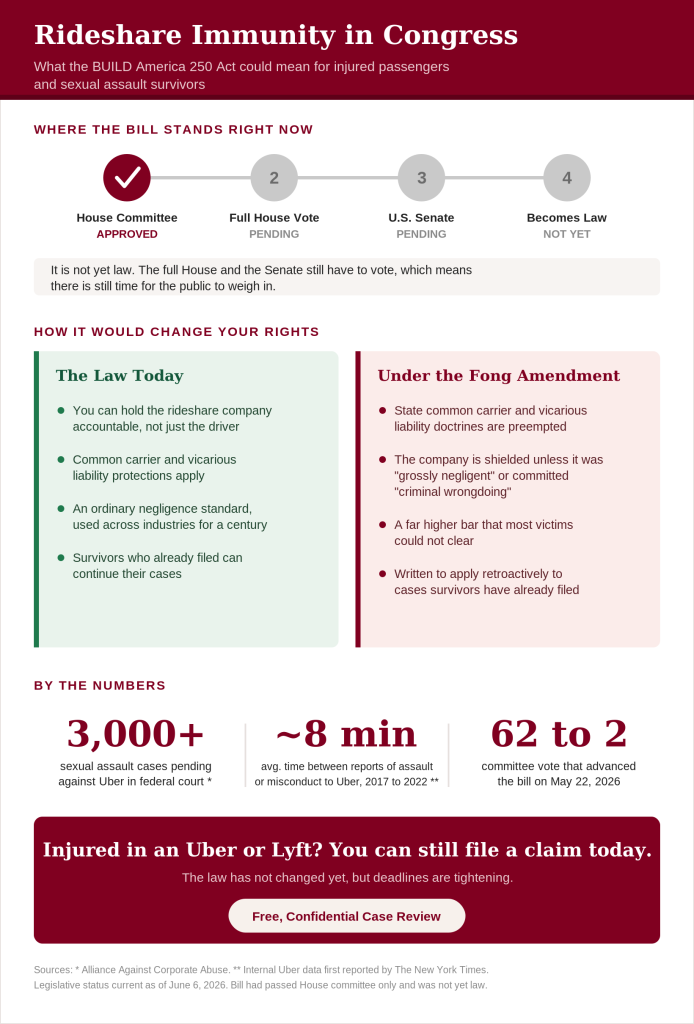
The Fong amendment would expressly preempt state common carrier, non-delegable duty, and vicarious liability doctrines as they apply to app-based rideshare companies. In plain English, it would block injured passengers from holding companies like Uber, Lyft, and Waymo legally responsible for harm caused by their drivers unless the victim can prove the company itself was "grossly negligent" or engaged in "criminal wrongdoing." That is a dramatically higher bar than the ordinary negligence standard that has governed nearly every other industry for more than a century, and for most victims it would be nearly impossible to clear.
It is worth being clear about one point, because some headlines have blurred it. This bill has not yet become law. As of early June 2026 it has only cleared committee, and it still needs a full vote on the House floor and then passage in the Senate before it could be signed into law. There is still time to influence the outcome, which is exactly why public attention matters right now.
To understand the stakes, it helps to understand why holding the company accountable matters in the first place. When a rideshare driver causes a crash or harms a passenger, that individual driver is often underinsured or has limited personal assets. The party with deeper pockets, and frequently the only party with real power to change safety practices, is the company that built the platform, set the rules, vetted the driver, and profited from the ride.
Legal doctrines like vicarious liability and common carrier duty are what allow victims to reach that company. Common carrier status in particular has long imposed a heightened duty of care on businesses that transport the public, from taxis to buses to trains. Stripping rideshare companies of that responsibility would treat a multibillion-dollar transportation network as though it were a passive bystander to what happens in its own cars. For a fuller explanation, see our guide to how rideshare liability works.
The most alarming feature of the amendment is that, by its plain terms, it is retroactive. It would apply to lawsuits filed on or after the date of enactment "without regard to whether the harm... occurred before such date."
According to the Alliance Against Corporate Abuse, that language would undercut the legal basis for the more than 3,000 sexual assault cases currently pending against Uber in federal multidistrict litigation, cases brought by people who have already filed and are already in court. Internal company data first reported by The New York Times indicated that, between 2017 and 2022, Uber received a report of sexual assault or misconduct on average roughly every eight minutes. If you are weighing a claim of your own, our Uber and Lyft sexual assault claims page explains your options.
The amendment surfaced shortly after a second federal jury found Uber liable for a driver's sexual assault, and weeks after a California ballot measure on rideshare safety and accountability qualified for the November 2026 ballot.
Uber has publicly backed the federal legislation, in part as a way to head off state-level accountability efforts, while the trial bar and consumer advocates are mobilizing against it.
The American Association for Justice (AAJ) has come out forcefully. "What could have been a bipartisan package to make Americans safer on the road has become an unprecedented attempt to give immunity to companies responsible for sexual assault, life-altering injuries, and deaths," said AAJ CEO Linda Lipsen after the committee vote, urging the House to block the provision.
We share that view. Reasonable people can debate how best to regulate the gig economy, but a rule that quietly erases pending sexual assault claims and immunizes a single industry from ordinary negligence law deserves open daylight and real debate rather than a 2 a.m. committee vote buried inside a highway bill.
If you or a loved one has been injured in a rideshare crash or harmed by a driver, the most important takeaway is that the law as it stands today still allows you to pursue a claim against the rideshare company, even though that could change.
Statutes of limitations already impose strict deadlines on personal injury and assault claims, and those deadlines vary by state. The proposed federal immunity would add a second clock on top of them. Because the amendment is written to apply to cases filed after enactment, the timing of when you file could directly affect whether you can hold the company accountable at all. If you have been considering a claim, this is not a moment to wait and see, because the sooner your case is evaluated and filed, the better positioned you will be regardless of what Congress ultimately does.
There are two things you can do today.
If you have been hurt, contact our firm for a free, confidential case evaluation. We handle Uber and Lyft accident and assault cases nationwide, and we will help you understand your rights under the law as it exists now. There is no cost to talk to us, and you pay nothing unless we recover for you.
If you want to be heard, remember that this bill is not law yet. You can find and contact your U.S. Representative and your U.S. Senators and tell them you oppose stripping rideshare victims of their right to hold companies accountable. Public attention is precisely what provisions like this are designed to avoid.
Rideshare companies have asked Congress to put them above the law that applies to everyone else. Survivors and injured passengers deserve a seat at that table, and a day in court.
Can I still sue Uber or Lyft after an accident in 2026?
Yes. As of June 2026 the proposed federal immunity has not become law, so the existing state-law rules still apply and you can pursue a claim against the rideshare company as well as the driver. Because filing deadlines vary by state and the law could change, it is wise to have your case evaluated promptly rather than waiting.
What is the BUILD America 250 Act rideshare amendment?
It is a provision authored by Rep. Vince Fong (R-CA) and attached to a federal surface transportation reauthorization bill. The amendment would preempt state common carrier, non-delegable duty, and vicarious liability doctrines for app-based companies, which means Uber, Lyft, and similar companies could not be held liable for harm caused by their drivers unless the company itself was grossly negligent or committed criminal wrongdoing.
Does the rideshare immunity bill affect sexual assault cases?
Yes. The amendment is written to apply retroactively, regardless of when the harm occurred. Advocates warn that it would undercut the legal basis for the more than 3,000 sexual assault cases pending against Uber in federal multidistrict litigation, including cases that survivors have already filed and are actively litigating.
Has Congress passed rideshare immunity into law yet?
No. As of early June 2026 the bill has only been approved by the House Transportation and Infrastructure Committee. It still needs a full vote on the House floor and passage in the Senate before it could be signed into law, so there is still time for the public to weigh in.
This article is for general informational purposes and reflects the status of pending federal legislation as of June 6, 2026. It is not legal advice, and legislation may change. For advice about your specific situation, please contact a qualified attorney. If you are a survivor of sexual assault and need support, help is available through the National Sexual Assault Hotline at 800-656-4673.
If you were hurt in an Uber, Lyft, or other rideshare crash, the insurance picture is layered and time matters. Our rideshare accident team can sort it out at no cost to you.
Get a free, no-obligation case review. We're available 24/7 and you pay nothing unless we win.
Related reading: Who Pays After an Uber or Lyft Crash in Illinois?
Related reading: What the Proposed Federal Rideshare Immunity Bill Means for Illinois Victims
John D. Risvold is an equity partner at Collins Law Group, P.C. in Naperville, Illinois. He represents individuals and families in catastrophic personal injury and wrongful death cases, focusing on commercial trucking crashes, rideshare and autonomous vehicle litigation, medical malpractice and birth injury, and product defect claims. He has tried cases to verdict in Illinois courts, recovered more than $50 million for clients over thirteen years of practice, and has been named to Best Lawyers in America for Personal Injury Litigation and Illinois Super Lawyers.